
Rising Seas Could Threaten Homes of 1.4 Crore People in Mumbai and Kolkata
 The Eastern Times
 Quick Summary
- Mumbai and Kolkata face major long-term risks as rising seas threaten densely populated coastal areas.
- Global sea-level rise reached 4.9 mm in 2024, highlighting the accelerating impact of climate change.
- South Asia faces multiple risks, from coastal flooding and erosion to glacier melt, drought, crop failures and food insecurity.
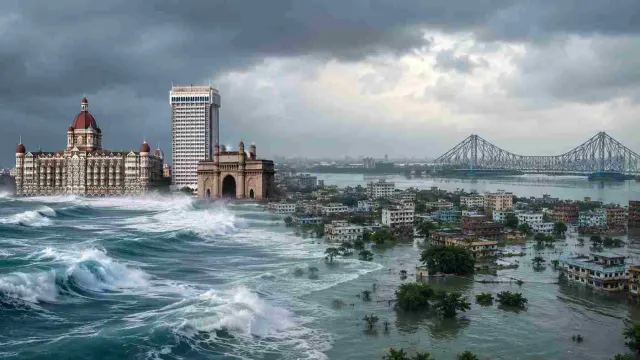
The sea that adds to the beauty and character of megacities such as Mumbai and Kolkata could become a growing threat to millions of their residents. Rising sea levels driven by global warming could eventually put the homes of nearly 1.4 crore (14 million) people across the two Indian cities at serious risk of permanent inundation, according to a United Nations report.
The warning comes as rising global temperatures accelerate the melting of glaciers and ice sheets, adding more water to the world's oceans. The consequences, the UN cautions, could extend far beyond flooding, threatening homes, infrastructure, livelihoods, cultural heritage and ecosystems in vulnerable coastal regions.
UN Raises Alarm Over Accelerating Sea-Level Rise
The UN report, released on Monday, highlights the growing impact of global warming on sea levels. Scientists have recorded a significant acceleration in the rate at which oceans are rising.
Between 2014 and 2023, global sea levels rose by an average of 4.2 millimetres per year. In 2024, the rate increased to 4.9 millimetres, marking an exceptionally high level of annual rise.
The report warns that continued global warming could keep sea levels rising rapidly through 2050, increasing pressure on coastal cities and communities around the world.
Key Findings
- Global warming is the primary driver of accelerating sea-level rise.
- Global sea level rose by 4.9 mm in 2024, compared with an average of 4.2 mm annually during 2014–2023.
- Mumbai and Kolkata face significant long-term coastal flooding risks.
- Coastal infrastructure and economies could suffer trillions of dollars in losses.
- South Asia faces interconnected risks from glacier melt, flooding, drought and food insecurity.
Mumbai, Kolkata Among Vulnerable Coastal Cities
The consequences could be particularly severe for densely populated coastal cities. The report identifies cities such as Miami, Buenos Aires and Shanghai as being exposed to potentially enormous economic losses from rising seas. Estimated damage to high-value coastal infrastructure in some major cities could run into $3.5 trillion to $7 trillion.
In South Asia, the risks are particularly acute. Coastal regions of Odisha, along with major cities including Mumbai and Kolkata in India and Dhaka in Bangladesh, face the possibility of severe flooding as sea levels continue to rise.
The potential impact on Mumbai and Kolkata is especially concerning because millions of people live in low-lying and densely populated urban areas. The report warns that the homes of approximately 1.4 crore people across the two cities could eventually face permanent inundation under severe sea-level-rise scenarios.
The consequences would not be limited to the loss of homes. Coastal communities could face disruptions to healthcare, food supplies, fisheries, drinking water, transportation, electricity networks and livelihoods. Valuable cultural heritage and local ecosystems could also be damaged or lost.
Odisha Faces a Wider Coastal Challenge
For Odisha, the warning carries particular significance. The state has a long and densely populated coastline, with communities dependent on agriculture, fisheries and other coastal livelihoods.
Rising seas, coastal erosion and increasingly intense climate-related events could put agricultural land and freshwater resources under growing pressure. The loss of fertile coastal land could have consequences not only for farmers but also for regional food security.
The 'Third Pole' and South Asia's Future
The UN report also draws attention to the Himalayan region, often described as the "Third Pole" because it contains the largest concentration of ice outside the Arctic and Antarctic.
Accelerating glacier melt could create a complex chain of risks for South Asia. In the coming decades, increased melting could contribute to greater flood risks, while the longer-term loss of glacier ice could reduce water availability during dry periods.
This creates the possibility of a dangerous cycle: glacial melt could initially increase flooding, followed by water shortages, droughts, crop failures and worsening food insecurity.
The stakes are enormous. Hundreds of millions of people in South Asia depend directly or indirectly on water originating from the Himalayan region.
A Threat That Extends Beyond the Coast
Sea-level rise is no longer simply a future environmental concern. Coastal cities are already experiencing increasing pressure on urban land, drainage and water systems, transportation networks, electricity infrastructure, buildings and groundwater resources.
For countries such as India, the challenge is therefore not limited to reducing greenhouse-gas emissions. Governments and cities will also need to invest in coastal protection, climate-resilient infrastructure, early-warning systems, disaster preparedness and long-term urban planning.
The UN's warning underscores a difficult reality: the rising sea could reshape where and how millions of people live in the decades ahead.
Reader Feedback
Was this article useful?
Stay Connected
Get the next important story before you miss it.
Subscribe to the newsletter for trusted updates, or join our WhatsApp channel for quick top-story alerts from The Eastern Times.
WhatsApp Channel
Prefer instant alerts? Join our WhatsApp channel for top stories and breaking updates.
Join on WhatsApp