
Right to Die with Dignity: Supreme Court Allows Withdrawal of Life Support in Passive Euthanasia Case.
 The Eastern Times
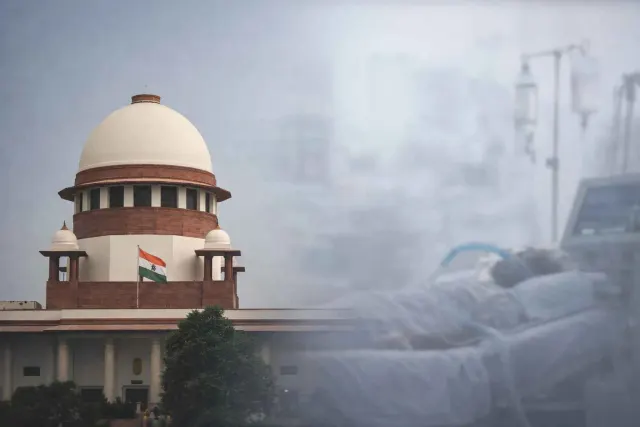
 New Delhi: The Supreme Court of India today delivered an important order in a passive euthanasia case, allowing the withdrawal of life support for a patient who has been in a prolonged coma following a tragic accident.
A bench comprising Justice J.B. Pardiwala and Justice K.V. Viswanathan permitted the withdrawal of life-sustaining treatment after examining the patient’s medical condition and the recommendations of medical authorities.
Case Background
The case concerns Harsh Rane (32), who met with a serious accident in 2013 after falling from a fourth-floor balcony when he was 19 years old. The accident left him in a coma, and he has remained in that condition for nearly 13 years.
During this period, he was kept alive through Clinically Assisted Nutrition (CAN), a medical method used to provide nutrition to patients who cannot eat or drink on their own.
According to petition before the court, the patient’s parents and the concerned medical boards concluded that continuing life support was no longer benefiting him, as there had been no signs of improvement in his condition for years.
Considering these factors, the Supreme Court allowed the withdrawal of life support.
The bench noted that the decision is consistent with the fundamental right to die with dignity, which has been recognized as part of the right to life under the Constitution.
The petition seeking permission to withdraw life support was filed through the patient’s father.
What is Passive Euthanasia?
Passive euthanasia refers to the withdrawal or withholding of life-sustaining medical treatment—such as ventilators, feeding tubes, or artificial nutrition—when a patient is in an irreversible medical condition with no reasonable chance of recovery.
Unlike active euthanasia, where deliberate action is taken to end a patient’s life, passive euthanasia allows the patient to die naturally by discontinuing medical support that artificially prolongs life.
In India, the Supreme Court has recognized passive euthanasia under strict legal safeguards, emphasizing the principle of “right to die with dignity.”
When Was the Right to Die with Dignity Recognised?
The Supreme Court recognised the right to die with dignity as part of the right to life under Article 21 of the Constitution in March 2018 in the landmark Common Cause case. A five-judge bench ruled that passive euthanasia could be permitted for terminally ill patients or those in a permanent vegetative state under strict safeguards.
Simplification of Living Will Procedure (2023)
In January 2023, the Supreme Court modified the guidelines issued in the 2018 judgment and simplified the procedure for executing “Living Wills.” The move made it easier for individuals to record their wishes in advance regarding medical treatment in case they become terminally ill or unable to communicate their decisions.
Reader Feedback
Was this article useful?
Stay Connected
Get the next important story before you miss it.
Subscribe to the newsletter for trusted updates, or join our WhatsApp channel for quick top-story alerts from The Eastern Times.
WhatsApp Channel
Prefer instant alerts? Join our WhatsApp channel for top stories and breaking updates.
Join on WhatsApp