
Post-Poll Party Switching: 111 MPs, MLAs Changed Sides Since 2022
 The Eastern Times
 Quick Summary
- ADR says 111 MPs and MLAs changed political parties after winning elections between 2022 and 2026.
- Nagaland recorded the highest number of party switches, followed by West Bengal and Telangana.
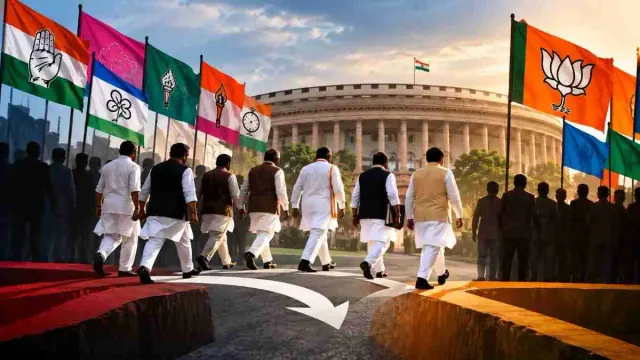
New Delhi, Sept 25: India's political landscape has seen significant changes after elections, with 111 elected MPs and MLAs changing political parties after winning their seats between 2022 and 2026, according to a new analysis by the Association for Democratic Reforms (ADR) and National Election Watch.
The ADR report, released on September 24, tracks sitting lawmakers who changed political affiliations after being elected to the Lok Sabha, Rajya Sabha or state assemblies. The data covers elections and by-elections during the period and is updated up to July 12, 2026.
The 111 cases comprise 26 Lok Sabha MPs, seven Rajya Sabha MPs and 78 MLAs. ADR said the cases fall into different categories, including individual defections, party mergers, resignations followed by by-elections and disqualifications followed by subsequent election victories.
Nagaland accounts for nearly one-third of cases
The largest concentration of party changes was recorded in Nagaland, which reported 32 cases. That represents around 29% of all the cases identified by ADR.
West Bengal followed with 20 cases, while Telangana recorded nine. Goa and Punjab each reported eight cases. Maharashtra and Meghalaya had six cases each, while Manipur recorded five. In total, the changes were spread across 17 states and Union Territories.
The developments in Nagaland were largely connected with the political realignment involving the Nationalist Democratic Progressive Party (NDPP) and the Naga People's Front (NPF).
NDPP records the highest number of exits
The ADR data also shows substantial movement away from several parties.
The NDPP recorded 25 lawmakers leaving, followed by the All India Trinamool Congress (AITC) with 20 and the Indian National Congress with 19.
The Bharat Rashtra Samithi (BRS) recorded nine exits, while the Aam Aadmi Party and Nationalist Congress Party each recorded seven. Six lawmakers from Shiv Sena (Uddhav Balasaheb Thackeray) were also included in the list.
Together, NDPP, AITC and Congress accounted for 64 of the 111 cases, or about 58% of the total.
NPF and BJP among major recipients
The movement was not one-sided. ADR's analysis also records the parties that received lawmakers who changed affiliations.
The Naga People's Front received 32 lawmakers, followed by the BJP with 29 and the Nationalist Citizens Party of India (NCPI) with 20.
In West Bengal, ADR recorded 20 Lok Sabha MPs who were elected on AITC tickets and subsequently moved to NCPI. The MPs have claimed a merger with NCPI, with the matter pending before Lok Sabha Speaker Om Birla.
What the report says about defections
ADR has divided the cases into four broad categories. These include lawmakers leaving their parties during their terms, formal party mergers, resignations followed by successful by-election contests, and cases involving disqualification followed by another election victory.
The organisation has argued that the findings highlight continuing questions surrounding India's anti-defection framework.
Among its recommendations, ADR has called for changes to the Tenth Schedule of the Constitution and a time-bound mechanism for deciding disqualification petitions. It has also proposed changes to the authority responsible for deciding such cases and restrictions on defectors holding public office before securing a fresh mandate.
ADR has cautioned that its database may not capture every instance of party switching because there is no single comprehensive official system that continuously records all such changes.
The report therefore offers a snapshot of post-election political realignments between 2022 and 2026, showing how party affiliations changed among elected representatives even after voters had chosen them on a particular party ticket.
What Is the Anti-Defection Law?
India’s anti-defection law under the Tenth Schedule provides for disqualification of legislators who voluntarily give up their party membership or vote against the party’s direction in certain circumstances.
However, not every party switch automatically leads to disqualification. The law also provides a merger exception when at least two-thirds of a legislature party agrees to the merger.
The Speaker or Chairman generally decides disqualification questions under the Tenth Schedule. Therefore, ADR’s 111 cases should not be treated as 111 cases of illegal defection.
Reader Feedback
Was this article useful?
Stay Connected
Get the next important story before you miss it.
Subscribe to the newsletter for trusted updates, or join our WhatsApp channel for quick top-story alerts from The Eastern Times.
WhatsApp Channel
Prefer instant alerts? Join our WhatsApp channel for top stories and breaking updates.
Join on WhatsApp