
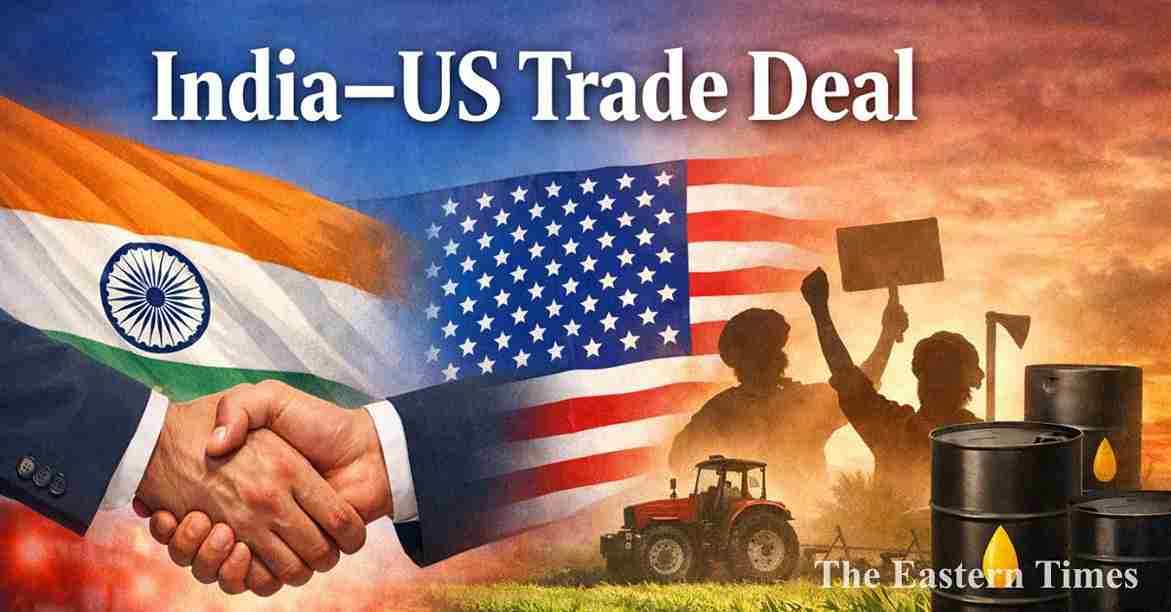
On February 7, 2026, India and the United States unveiled an interim trade arrangement following discussions between Prime Minister Narendra Modi and US President Donald Trump.
While both sides have presented the agreement as a step towards stronger economic cooperation, its details have opened up debate in India over trade balance, energy policy, and farmer welfare.

What does the agreement change?
Under the interim framework, the US will reduce import duties on Indian goods to about 18%, down from earlier levels that had reached 50% due to penalty tariffs.
In return, India has agreed to lower its regular tariffs on most US industrial products and a number of agricultural and food items.
What is the $500 billion commitment?
India has expressed its intention to purchase $500 billion worth of American goods over five years. These purchases are expected to focus on:
Energy supplies
Aircraft
Advanced technologies such as GPUs
Coking coal
The government says this reflects India’s growing economy and rising demand.
Who could benefit in India?
Export-focused industries such as textiles, leather, gems and jewellery, and pharmaceuticals are expected to gain from improved access to the US market.
Commerce Minister Piyush Goyal has argued that the reduced US tariff rate is among the lowest offered to its trading partners and will help labour-intensive sectors.
Why are some experts unhappy?
Trade researchers at the Global Trade and Research Initiative believe the deal places a heavier burden on India.
Their concern is that India is opening its market broadly, while the US is only easing tariffs that applied to just over half of Indian exports. Opposition leaders such as P. Chidambaram have described this imbalance as clearly favouring Washington.
Also Read: FIR Registered in Leak Case of General MM Naravane’s Unpublished Book
What is the issue around Russian oil?
Conflicting signals have emerged on India’s oil imports. President Trump claimed India would stop buying Russian crude, but the joint statement makes no such commitment.
A US executive order suggests that higher tariffs could return if Russian oil purchases continue. Strategic affairs expert Brahma Chellaney has said this amounts to trade pressure being used to influence India’s foreign policy choices.
The Indian government maintains that oil purchases are commercial decisions taken by private companies.
Why are farmers protesting?
Farm unions fear that cheaper imports of products like soybean oil, sorghum, nuts, and animal feed could push down domestic prices.
The Samyukt Kisan Morcha has warned that Indian farmers could suffer income losses and has announced plans to intensify protests.
The government says no concessions have been given on dairy, wheat, rice, poultry, or genetically modified products, and claims farmer safeguards remain intact.
Is the $500bn target achievable?
Economists have raised doubts about whether India can realistically meet the $500 billion import goal.
They argue that imports from the US would need to rise sharply and consistently, which could strain India’s trade balance and external finances. Supporters of the deal counter that India’s expanding economy will naturally increase import demand over time.
What happens next?
Final negotiations are still ongoing. Until clearer terms are released and debated in Parliament, questions around transparency, farmer protection, and strategic autonomy are likely to persist—despite positive reactions from sections of industry and financial markets.

click on icons to connect with us through official social media channels






You May Be Bathing the Wrong Way: Know the Correct Ayurvedic Way
