
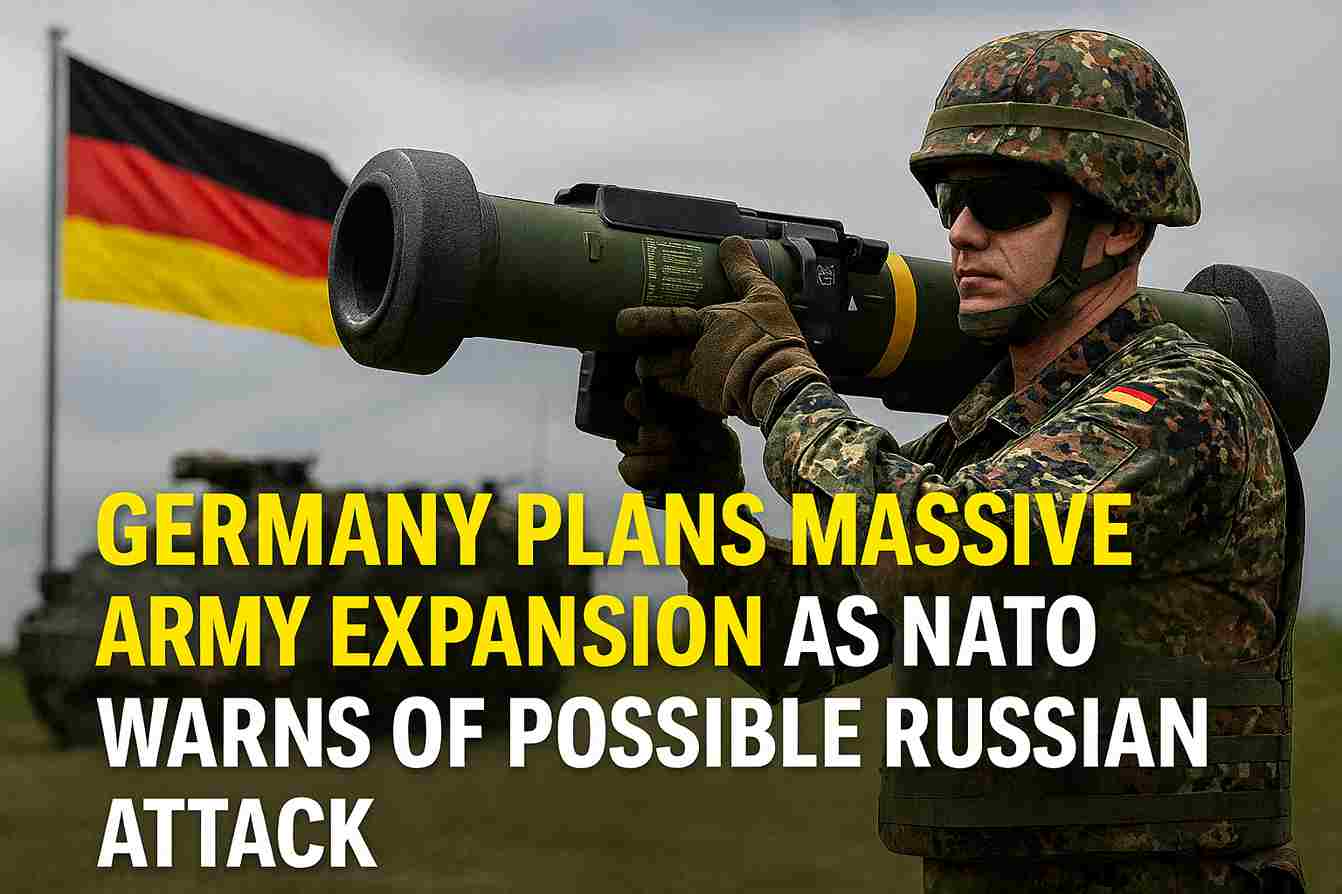
Germany Announces Biggest Military Expansion Since the Cold War
Germany is launching its most ambitious military buildup in decades, as Chancellor Friedrich Merz vows to transform the Bundeswehr into Europe’s strongest conventional army.
The shift comes amid NATO warnings of a potential Russian attack by 2029, growing doubts about US support, and a Europe rapidly rethinking its security.
Germany’s New Military Plan: What Will Change
The coalition government approved sweeping reforms aimed at expanding the Bundeswehr from 180,000 active troops to 260,000 by 2035, plus 200,000 reservists.
Key changes include:
New voluntary enlistment drives
Higher starting salary of €2,600 (up €450)
Mandatory questionnaires for all 18-year-olds starting 2025
Compulsory medical screenings for men by 2027
Mandatory service as a fallback if recruitment is insufficient
This marks the biggest shift since Germany suspended conscription in 2011.
⚠️ Why Now? A Security Environment Changing Fast
NATO’s top commanders have warned that Europe could face a Russian military challenge within the decade.

Gen. Carsten Breuer, Germany’s chief of defense, said NATO must be “prepared for a Russian attack by 2029,” calling the current landscape the most dangerous in years.
Other factors driving the shift:
Russia’s continued war in Ukraine
Uncertain long-term US involvement in NATO
Growing security anxiety across Eastern Europe
Germany’s economy and central location make it the natural anchor for European defense — if it can rebuild its military quickly enough.
🏛️ Political Divisions Inside the Coalition
Before reaching consensus, governing parties debated several models:
❌ Rejected: Lottery-style conscription
This would have randomly selected young men for compulsory screenings.
✔ Accepted: Incentive-based recruitment
Defense Minister Boris Pistorius pushed for a system that encourages service rather than forces it.
The Bundestag will vote by year-end, with the new system expected to begin 1 January 2026.
🧭 Public Response: Support and Anxiety
Conscription remains controversial. A Forsa poll shows:
80% of Die Linke voters oppose it.
Young people express mixed emotions — some support national defense, others fear losing personal freedom.
Conscientious objector requests have surged to 3,000+, the highest since 2011.
🪖 Decades of Decline Behind This Big Shift
After the Cold War, Germany cut spending, fell below NATO’s 2% target, and allowed the Bundeswehr to deteriorate.
Russia’s 2022 invasion of Ukraine ended this era. Former Chancellor Olaf Scholz called it a Zeitenwende and launched a €100 billion modernization fund.
Chancellor Merz is going even further — doubling defense commitments and promising a military capable of deterring any attack.
⭐ Analysis: What This Military Pivot Means for Europe
1. Germany is stepping into a leadership void
With the US unpredictable and Eastern Europe under pressure, Berlin is positioning itself as Europe’s core military power.
2. Conscription could reshape German society
Even as a backup, mandatory service challenges Germany’s post-WW2 pacifist identity.
3. Europe’s security map is quietly shifting
If Germany expands successfully, France, the UK and Italy may be forced to increase their defense spending too.
4. The timeline remains the biggest risk
Germany’s full transformation is planned for 2035 — but NATO’s threat window could come years earlier.
🟡 Bottom Line
Germany’s rebuild is late and controversial, but European military planners say it’s now unavoidable.
As Defense Minister Pistorius put it:
“The stronger we are, the less likely we are to face war.”
https://theeasterntimes.com/russia-conducts-full-nuclear-drill/
Russia Conducts Full Nuclear Drill Amid Rising Tensions with NATO
Connect with us through social media
Facebook:
 https://www.facebook.com/profile.php?id=61577015427068
X (Twitter):
 https://x.com/tet_editor
Instagram:
 https://www.instagram.com/the_eastern_times_/?next=%2F&hl=en
Mail (Email):
 contact.theeasterntimes@gmail.com