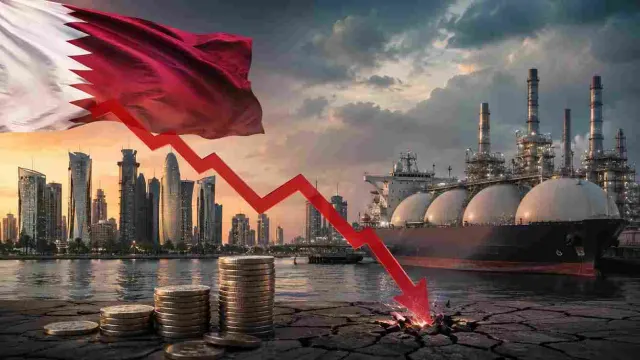
Qatar Economy in Trouble as LNG Exports Fall 96%
 The Eastern Times
 Quick Summary
- Qatar’s LNG exports have reportedly fallen by 96%.
- The country faces an estimated $24 billion loss in gas sales.
- IMF forecasts an 8.6% contraction in Qatar’s economy in 2026
Qatar, one of the world’s biggest exporters of liquefied natural gas (LNG), is facing a major economic shock after months of conflict between the United States and Iran disrupted its gas production and export routes.
The crisis has struck at the heart of Qatar’s economy. LNG is a major source of export earnings and government revenue, and the reported 96% fall in LNG shipments has sharply reduced the flow of money into the Gulf state.
From 509 LNG Cargoes to Just 18
The scale of the crisis is clear from Qatar’s LNG export figures.
During the comparable period last year, Qatar reportedly shipped 509 LNG cargoes. This year, the figure has fallen to just 18 cargoes, a decline of about 96%.
Before the conflict, Qatar supplied nearly one-fifth of global daily LNG demand, making it one of the most important suppliers in the international energy market.
The Crisis in Numbers
- 509 → 18: LNG cargoes during the comparable period
- 96%: Reported fall in LNG shipments
- $24 billion: Estimated loss in gas sales
- 30%: Reported cuts in some government department budgets
- 85%: Approximate reduction in foreign-aid spending
- 8.6%: IMF forecast for Qatar’s economic contraction in 2026
- 17%: LNG capacity affected by damage to two production trains
- 3–5 years: Possible repair period
- $500 billion: Estimated assets of Qatar’s sovereign wealth fund
Why Has Qatar Been Hit So Hard?
Qatar depends heavily on natural gas. Oil and gas provide a major share of its government income and exports.
The country also relies heavily on the Strait of Hormuz to transport LNG to international markets. When the conflict disrupted shipping through the strategic waterway, Qatar’s ability to export gas was severely affected.
This created a major problem for an economy built around energy exports.
Damage to Ras Laffan
The situation became more serious after missile and drone attacks reportedly targeted Ras Laffan, Qatar’s main LNG production and export centre.
QatarEnergy has said damage to two LNG production trains reduced the country’s export capacity by around 17%.
Repairing the damaged facilities could take three to five years, meaning Qatar may not quickly return to its previous export capacity even if shipping conditions improve.
$24 Billion in Lost Gas Sales
The collapse in LNG exports has already created a huge financial loss.
Qatar is estimated to have lost around $24 billion in gas sales during the conflict, equal to several months of the country’s income.
The government has responded by reducing spending. Some government department budgets have reportedly been cut by as much as 30%, while foreign-aid spending has fallen by around 85%.
If the disruption continues, further spending cuts could follow.
Economy Could Contract 8.6%
The impact is also visible in Qatar’s economic outlook.
The International Monetary Fund (IMF) expects Qatar’s economy to contract by 8.6% in 2026.
For a country that has enjoyed years of growth powered by its gas industry, such a contraction would represent a major economic setback.
Lower LNG exports mean lower foreign earnings and government revenue. Prolonged disruption could also weaken investment and economic activity.
Qatar Is Rich, But Not Untouchable
Despite the scale of the crisis, Qatar is not bankrupt.
Its biggest financial strength is its enormous sovereign wealth. The Qatar Investment Authority is estimated to have around $500 billion in assets.
Qatar’s population is also relatively small, at around 3.1–3.2 million, allowing the government to use its financial reserves to support the domestic economy.
This gives Doha considerable room to absorb losses.
But the longer the crisis lasts, the more reserves Qatar may have to use while its main source of income remains under pressure.
How Long Can Qatar Absorb the Shock?
The immediate crisis is serious, but the bigger question is how long it will continue.
If LNG production and shipping return to normal soon, Qatar can use its financial reserves to cover much of the damage.
A prolonged crisis would be much harder to manage. Continued losses could force deeper government spending cuts and greater use of the country’s accumulated wealth.
The disruption could also affect the overseas investment strategy of Qatar’s sovereign wealth fund as the government balances long-term investments with immediate financial needs.
Qatar’s Economic Engine Under Pressure
Qatar has not been financially ruined. Its huge reserves give it a strong cushion against the current crisis.
But its most important economic engine—LNG exports—has suffered a major blow.
The numbers show the scale of the change: 509 LNG cargoes have fallen to just 18, exports have dropped about 96%, and an estimated $24 billion in gas sales has been lost.
For one of the world’s richest energy states, the crisis is a stark reminder that even enormous wealth cannot completely protect an economy when its main source of income and critical export route are disrupted for a prolonged period.
Impact on the World and India
Qatar’s LNG crisis is not only a problem for the Gulf state. It has also created concerns for the global energy market and India, one of Qatar’s biggest LNG customers.
Before the conflict, Qatar supplied around one-fifth of global LNG demand and nearly half of India’s LNG imports. The disruption has therefore created a major gap in international gas supplies.
India–Qatar Energy Trade
Qatar is a key energy partner for India, with LNG forming the largest part of the energy trade between the two countries.
-
In FY 2024–25, India imported about $6.39 billion worth of LNG from Qatar.
-
India’s total imports of petroleum and gas products from Qatar were about $11.9 billion, including LNG, propane, butane and crude oil.
-
India’s total imports from Qatar stood at about $12.46 billion, while its exports to Qatar were around $1.68 billion.
-
Before the current West Asia conflict, Qatar supplied nearly half of India’s LNG imports.
-
After the disruption to shipping through the Strait of Hormuz, Qatar supplied no LNG to India in April and May 2026, according to Indian customs data.
-
India responded by increasing LNG purchases from countries such as the United States, Oman, Nigeria, Trinidad and Angola.
-
India also has a long-term LNG relationship with Qatar. Petronet LNG’s 2024 agreement added 7.5 million tonnes of LNG per year from 2028 to 2048.
What It Means for India
The disruption has forced India to diversify its LNG sources. This gives India more flexibility, but alternative supplies can come at a higher cost.
Higher LNG prices can increase costs for industries that depend on natural gas, particularly fertiliser, power, chemicals and manufacturing. A prolonged disruption could also increase India’s energy import bill and add pressure to inflation.
For Qatar, India is an important long-term market. For India, Qatar is an important source of affordable LNG.
The crisis has therefore exposed the risks of depending heavily on one supplier and one major shipping route. India’s growing LNG diversification could become an important part of its energy-security strategy in the years ahead.
Reader Feedback
Was this article useful?
Stay Connected
Get the next important story before you miss it.
Subscribe to the newsletter for trusted updates, or join our WhatsApp channel for quick top-story alerts from The Eastern Times.
WhatsApp Channel
Prefer instant alerts? Join our WhatsApp channel for top stories and breaking updates.
Join on WhatsApp