Not Degrees, but Skills Matter for Employability: NITI Aayog Report
 The Eastern Times
 Quick Summary
- Only 8.25% of graduates are employed in jobs related to their educational qualifications, highlighting India’s growing employability challenge.
- Skills matter more than certificates, with employers increasingly seeking practical abilities, problem-solving, communication and digital skills.
- NITI Aayog recommends major reforms, including employability skills from Classes 6–12, apprenticeships, Digital Skill Passports and lifelong learning.
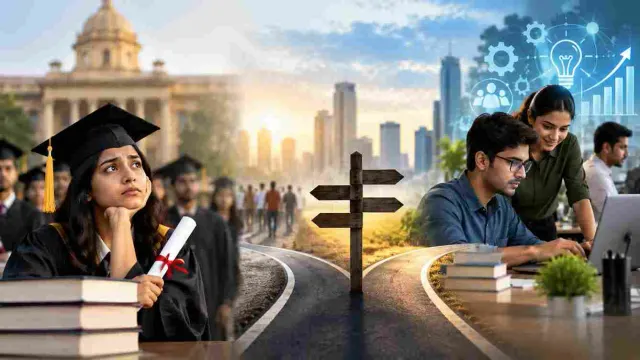
India is producing more graduates than ever, but a degree alone is no longer enough to secure a job. NITI Aayog’s latest analysis highlights a widening gap between what colleges teach and what employers need, raising serious questions about employability, skills and the future of higher education.
A Degree, But Not Always a Job
There was a time when earning a college degree was seen as a reliable pathway to employment. Today, that equation is changing.
India’s expanding higher education system is producing millions of graduates, but many are finding that their qualifications do not match the requirements of the job market. The result is a growing degree-versus-skills crisis.
The numbers are particularly concerning. Only 8.25% of graduates are employed in jobs related to their educational qualifications. Around 13% of graduates are unemployed, while graduate unemployment among women stands at an even higher 20.4%.
The figures point to a deeper problem: earning a degree does not necessarily mean being ready for employment.
Employers Are Looking Beyond Degrees
In its recently published draft paper, “Education and Skilling for Employability: From Credentials to Learning Outcomes,” NITI Aayog argues that certificates alone are becoming less valuable in the modern job market.
What employers increasingly want is the ability to solve problems, communicate effectively, use digital tools, adapt to new situations and apply knowledge in real-world settings.
India’s education system, however, remains heavily focused on examinations, academic credentials and degrees.
The gap between these two approaches is becoming increasingly difficult to ignore.
What Students Study vs What Jobs Need
The traditional career formula was straightforward: study a subject, earn a degree and find a job in the same field.
That model is no longer guaranteed.
One of the biggest reasons is the widening gap between academic curricula and industry requirements. Many courses are not being updated quickly enough to keep pace with technology and changes in the workplace.
As a result, companies often have to provide additional training after hiring graduates.
For employers, this means higher training costs. For students, it means spending years earning a qualification without necessarily acquiring the skills needed to use it.
Millions Are Choosing Traditional Degrees
Traditional undergraduate programmes continue to attract huge numbers of students.
Around 1.3 crore students are enrolled in BA programmes, while approximately 3.4 crore students are enrolled collectively in BA, BCom and BSc programmes.
These degrees continue to have academic and social value, but they are not always directly connected to employment opportunities.
That raises a fundamental question: Are students being prepared for careers, or simply being prepared to earn degrees?
The answer could determine how India approaches higher education in the coming years.
More Skill Training, But the Jobs Gap Remains
India has significantly expanded its focus on skill development.
Since 2014-15, more than 2.66 crore people have received skill training. The 2025-26 Budget has allocated around ₹34,000 crore for skill development and training.
But there is a catch.
More training has not automatically resulted in more employment.
This suggests that the problem is not simply a shortage of training programmes. The bigger challenge is ensuring that training is relevant, high-quality and connected to actual employment opportunities.
Start Preparing Students in School
NITI Aayog believes the solution needs to begin much earlier than college.
It has recommended introducing General Employability and Entrepreneurship Skills (GEAES) for students from Classes 6 to 12.
The objective is to help young people understand the world of work before they enter higher education or begin looking for jobs.
Skills such as communication, problem-solving, entrepreneurship and workplace readiness could become part of a student's educational journey rather than something they learn only after graduation.
Bring the Classroom Closer to the Workplace
NITI Aayog has also proposed an Integrated Shared Apprenticeship Platform that would bring different platforms together.
Such a system could make it easier for students and young job seekers to find apprenticeship opportunities and access information about eligibility, employment prospects and stipends.
The idea is simple: students should get exposure to the workplace before they are expected to compete in it.
Apprenticeships and practical experience could help bridge the gap between classroom learning and actual employment.
Measure Education by Outcomes
NITI Aayog has also suggested changing the way education is evaluated and funded.
Instead of focusing mainly on enrolment numbers, institutions should also be assessed on outcomes such as sustained employment and wage growth.
In other words, the success of an education system should not be measured simply by how many students enter college or receive degrees.
It should also ask a more important question: What happens to them after graduation?
A Passport for Skills
The report has proposed a Digital Skill Passport that could track an individual's skills, certifications and work experience.
Such a system could help employers understand what candidates can actually do rather than relying solely on academic qualifications.
It could also give workers a portable record of their abilities as they move between jobs, industries and training programmes.
Learning Cannot Stop at Graduation
NITI Aayog has also emphasised the importance of lifelong learning.
Technology, industries and job roles are changing rapidly. Skills that are valuable today may become outdated tomorrow.
That makes continuous learning and reskilling increasingly important—not only for young graduates but also for people already in the workforce.
India Needs More Than Graduates
India’s challenge is no longer simply to produce more degree holders. It is to produce young people who can translate education into employment and build sustainable careers.
A degree can demonstrate that someone has completed a course of study. But in today's job market, employers increasingly want to know something more fundamental:
What can you actually do?
That may be the biggest shift facing India's education system—from measuring credentials to measuring capabilities.
The future of higher education could therefore depend not on how many degrees India awards, but on whether those degrees give young people the skills, experience and confidence to succeed in the real world.
Reader Feedback
Was this article useful?
Stay Connected
Get the next important story before you miss it.
Subscribe to the newsletter for trusted updates, or join our WhatsApp channel for quick top-story alerts from The Eastern Times.
WhatsApp Channel
Prefer instant alerts? Join our WhatsApp channel for top stories and breaking updates.
Join on WhatsApp