
Why India Wants Foreign Investment in Banana Farming
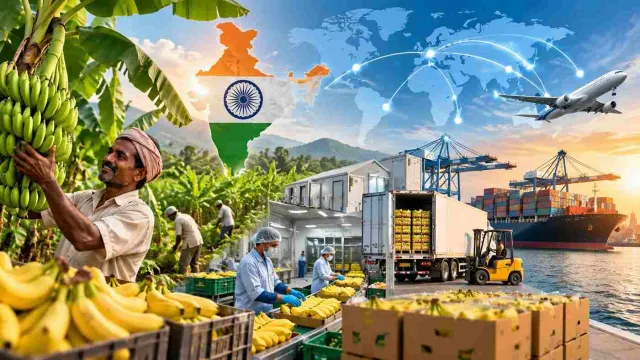 The Eastern Times
 Quick Summary
- India is considering allowing greater FDI in commercial crops such as bananas.
- India is the world's largest banana producer but has only about 1% of global exports.
- New investment could improve cold chains, technology and logistics and help push exports toward $1 billion.
India is preparing to consider a major change in its plantation-sector investment policy, with bananas emerging as one of the commercial crops that could be opened to greater foreign investment.
The Commerce and Industry Ministry is holding stakeholder consultations on liberalising Foreign Direct Investment (FDI) rules in the plantation sector. An official said the government is looking for "more FDI liberalisation in the plantation sector like banana."
The proposal comes at an interesting moment for India's banana industry. India is already the world's largest banana producer, but its share of international banana exports remains only around 1%. The government now wants to use investment, technology and better logistics to close that gap.
What Are the Existing FDI Rules?
At present, 100% FDI under the automatic route is permitted in tea, including tea plantations, coffee plantations, rubber plantations, cardamom plantations, palm-oil tree plantations and olive-oil tree plantations.
FDI is not permitted in other plantation-sector activities under the existing framework.
The proposed liberalisation would potentially bring additional commercial crops such as bananas into this framework.
The scale of investment already associated with plantation-linked sectors shows the potential. Between April 2000 and March 2026, India received $295.23 million in FDI in tea and coffee, including processing and warehousing, while rubber goods attracted about $3.93 billion.
The government's thinking is that similar investment could be attracted into other commercially important agricultural value chains.
India's Banana Paradox
The strongest argument for opening bananas to FDI is the enormous gap between India's production and exports.
India produced about 35.36 million metric tonnes of bananas, accounting for approximately 26.45% of global production, according to data cited by APEDA. Yet India's share of the global banana export market was only around 1%.
In other words, India grows an enormous quantity of bananas but captures only a small portion of the international trade.
That makes bananas different from a crop where the country simply needs to increase production.
India's bigger problem is converting production into exportable, higher-value agricultural output.
Exports Are Already Growing Rapidly
There are signs that India can become a much larger banana exporter.
In FY2024–25, India's banana exports reached $377.5 million, representing approximately 29.7% year-on-year growth. Banana shipments have increased about seven-fold since FY2018, making bananas India's largest fruit export by value in FY2024–25.
The government is targeting $1 billion in banana exports in the coming years. APEDA has estimated that achieving this target could increase farmers' incomes, improve the livelihoods of more than 25,000 farmers and generate employment for more than 50,000 aggregators directly or indirectly linked to the supply chain.
Reaching $1 billion would mean increasing exports by roughly 2.65 times from the FY2024–25 level.
That is ambitious, but the rapid growth of exports shows that the market is already expanding.
Where Are Indian Bananas Going?
Indian bananas have already established markets across the Middle East and neighbouring regions.
Major destinations include Iran, Iraq, the UAE, Oman, Uzbekistan, Saudi Arabia, Nepal, Qatar, Kuwait, Bahrain, Afghanistan and the Maldives.
Iraq has become particularly important. It accounted for approximately 47% of India's banana exports in FY2024–25, according to trade-data analysis.
But the opportunity extends beyond these existing markets.
The government and APEDA have identified countries including the United States, Russia, Japan, Germany, China, the Netherlands, the UK and France as potential expansion markets.
Why Foreign Investment Matters
Bananas are highly perishable, making post-harvest infrastructure critical. Foreign investment could support the development of modern packhouses, cold-storage facilities, refrigerated transportation, grading and sorting systems, quality-testing laboratories and export logistics.
International companies could also bring modern cultivation technology, improved planting material, better farm-management practices and established relationships with overseas buyers. This could help Indian farmers produce fruit that meets the quality, packaging and phytosanitary requirements of demanding markets.
India already exports bananas to countries including Iran, Iraq, the UAE, Oman, Saudi Arabia, Nepal and Qatar. Markets such as the US, UK, European Union, Japan and Russia could provide further opportunities.
Five States Stand to Benefit
The benefits could be particularly significant in India's major banana-producing states—Andhra Pradesh, Maharashtra, Karnataka, Tamil Nadu and Uttar Pradesh—which together account for nearly 67% of national production. Greater investment could connect these production clusters with integrated supply chains linking farmers to exporters and international markets.
It could also generate employment in packaging, warehousing, transportation, processing and logistics.
The Farmer Must Remain Central
However, FDI alone will not solve India's banana-export challenge.
Large companies could bring capital and technology, but excessive concentration in procurement could weaken farmers' bargaining power. The government will therefore need safeguards covering transparent contracts, fair pricing, farmer participation and dispute resolution.
The objective should be to integrate Indian farmers into global value chains rather than make them dependent on large corporations.
A Larger Agricultural Opportunity
The banana proposal reflects a broader change in India's agricultural strategy.
The challenge is no longer simply producing more. It is about getting more value from what India already produces.
Between April 2000 and March 2026, India received $295.23 million in FDI in tea and coffee, including processing and warehousing, while rubber goods attracted about $3.93 billion. The government now appears to be examining whether similar investment can be encouraged in other commercial agricultural sectors.
If implemented carefully, liberalising FDI in bananas could help India reduce post-harvest losses, modernise supply chains, increase exports, create jobs and potentially raise farmer incomes.
India already has the production advantage. The next challenge is to build the infrastructure and global market connections needed to turn that advantage into export power.
Reader Feedback
Was this article useful?
Stay Connected
Get the next important story before you miss it.
Subscribe to the newsletter for trusted updates, or join our WhatsApp channel for quick top-story alerts from The Eastern Times.
WhatsApp Channel
Prefer instant alerts? Join our WhatsApp channel for top stories and breaking updates.
Join on WhatsApp