
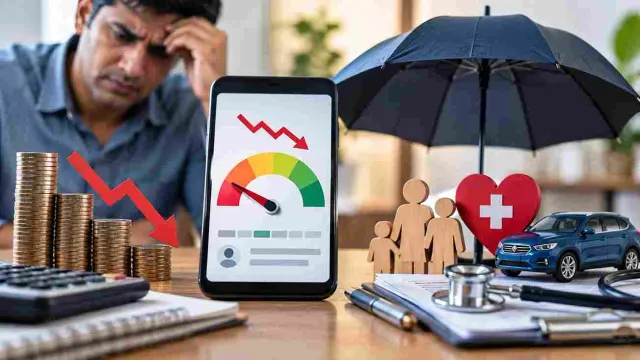
If Your Credit Score Drops, Will Your Insurance Premium Rise?
 The Eastern Times
 Quick Summary
- Low CIBIL score does not automatically increase health or motor insurance premiums in India.
- Insurers mainly assess health, vehicle details, claims history and other policy-specific risks.
- A poor credit score can affect loans and borrowing costs, but insurance works differently.
A credit score has become an important part of financial life in India. Whether it is a home loan, personal loan, car loan or credit card, banks increasingly use a person's credit history to assess how safely they can lend money.
This has also created a common concern among policyholders: If my credit score falls, will my health or motor insurance premium go up?
The answer is not directly.
A low credit score in India does not normally mean that an insurance company will automatically increase the premium. The reason is that lenders and insurers are looking at two different kinds of risk.
A simple example: one person, two different risks
Consider a 35-year-old salaried employee who missed several loan and credit-card payments during a period of financial difficulty. His credit score subsequently falls.
From a bank's point of view, this could be a warning sign. The bank may consider him a higher credit risk when he applies for another loan.
But suppose the same person is healthy, has no major pre-existing disease and has made very few health insurance claims.
His credit risk may have increased, but his health-insurance risk has not necessarily changed.
Therefore, a lower credit score alone would not normally result in a higher health insurance premium.
What health insurers actually look at
Health insurance is largely about the likelihood and potential cost of medical treatment.
Insurers may consider factors such as age, health condition, pre-existing diseases, previous surgeries or illnesses, family medical history, past claims and medical expenses when determining premiums.
Take the example of two 45-year-old people.
One has an excellent credit score but has a significant medical history. The other has a poor credit score but is otherwise healthy and has a low medical risk.
The person with the better credit score does not automatically get the cheaper health insurance. The insurer's primary concern is the medical risk covered by the policy, not simply how regularly the person has repaid a bank loan.
What about car and bike insurance?
Motor insurance works in a similar way.
Suppose a person has a CIBIL score that has fallen because of delayed loan payments. At the same time, he owns a five-year-old car, drives it regularly and has made several insurance claims in recent years.
If his motor insurance premium rises at renewal, the reason is more likely to be connected with the vehicle and its insurance risk, rather than the fall in his credit score.
Insurers can consider factors such as vehicle age, engine capacity, usage, location, driver's details, previous claims and Insured Declared Value (IDV) while calculating the premium.
The same principle applies to two-wheelers.
An Indian household example
Consider a family in Bhubaneswar that has a home loan, two credit cards, a family health insurance policy and a car.
The family's monthly finances may become tight after an unexpected expense, resulting in delayed credit-card payments. Their credit score may consequently fall.
The family may then face difficulty when applying for a new personal loan or could receive less favourable borrowing terms.
But this does not mean that their existing family health insurance premium will automatically rise because their CIBIL score has fallen.
If the insurer increases the premium at renewal, the family should check the actual reason for the increase—such as changes in age, medical risk, claims, healthcare costs or policy coverage.
This distinction is particularly important for Indian middle-class households, where loans and insurance are often part of the same monthly financial budget.
Why the confusion is understandable
The confusion is understandable because both banking and insurance involve the word "risk."
But they measure different risks.
A bank asks:
"Will this person repay the money we lend?"
An insurer asks:
"How likely is the insured event to happen, and how much could the claim cost?"
For a bank, repayment history is extremely important. For a health insurer, medical risk is much more relevant. For a motor insurer, the vehicle, driver, location and claims history matter more.
That is why a person can have a poor credit score but still have a relatively low insurance risk.
What does a credit score actually tell us?
A credit score primarily reflects a person's credit behaviour.
It can be affected by whether loans and credit-card bills are paid on time, how much available credit is being used, the number of credit accounts and how frequently new credit is requested.
For Indian borrowers, maintaining a healthy credit profile can therefore be important when planning major financial decisions such as buying a house, purchasing a vehicle or seeking a business loan.
A missed EMI may have consequences for future borrowing, but it should not automatically be interpreted as a reason for a higher insurance premium.
Where a low credit score can hurt financially
A falling credit score can still have a significant financial impact.
Suppose someone wants to buy a ₹10 lakh car and needs a vehicle loan. If their credit history is weak, they may find it more difficult to obtain favourable loan terms.
Similarly, someone planning to purchase a house may discover that their credit history affects the lender's assessment of the application.
In such cases, the person could end up paying more for borrowing.
But that additional cost is different from the insurance premium charged to protect the car or property.
This is the distinction policyholders need to understand.
Don't confuse a higher premium with a higher loan cost
Imagine that a person buys a car through financing.
There are two separate financial calculations:
Car loan: The lender assesses the borrower's ability and willingness to repay.
Motor insurance: The insurer assesses the risk associated with the vehicle and the coverage provided.
If the person's credit score falls, the first calculation may be affected. The second does not automatically change simply because the credit score has fallen.
This distinction can prevent unnecessary confusion when reviewing household expenses.
What should policyholders do when their premium rises?
If a health or motor insurance premium increases at renewal, policyholders should not immediately assume that their credit score is responsible.
Instead, they should check the renewal notice and understand what has changed.
For health insurance, they can look at changes related to age, medical risk, claims, coverage and healthcare costs.
For motor insurance, they can check claims history, vehicle details, IDV, usage and other policy-related factors.
If the reason for the increase is unclear, the policyholder can ask the insurer or intermediary for an explanation.
The Indian perspective
For many Indian families, credit, insurance and savings are closely connected. A family may simultaneously manage EMIs, credit-card payments, health insurance, vehicle insurance and investments.
This makes it easy to assume that a change in one financial indicator will affect everything else.
But the financial system does not work that way.
A credit score primarily answers a lending question. Insurance underwriting answers an insurance-risk question.
Understanding this difference is particularly useful at a time when more Indians are using formal credit and buying insurance products.
What Policyholders Should Know
A falling credit score is a warning sign for a person's borrowing profile, but it does not automatically translate into a higher health or motor insurance premium in India.
If your CIBIL score drops, the first place you may notice the financial impact is likely to be when you seek new credit or negotiate borrowing terms.
For insurance, the important question remains: What risk is the insurer covering, and what factors have changed that risk?
So, a poor credit score may make borrowing more difficult or expensive—but it should not, by itself, be treated as a reason for higher insurance premiums in India.
Reader Feedback
Was this article useful?
Stay Connected
Get the next important story before you miss it.
Subscribe to the newsletter for trusted updates, or join our WhatsApp channel for quick top-story alerts from The Eastern Times.
WhatsApp Channel
Prefer instant alerts? Join our WhatsApp channel for top stories and breaking updates.
Join on WhatsApp