Global Economy Caught Between Oil Shock and AI Boom: What It Means for India
 The Eastern Times
 Quick Summary
- Oil shock: Middle East tensions threaten energy supplies and could fuel inflation.
- AI boom: Rising investment in AI, semiconductors and data centres is creating new growth opportunities.
- India’s choice: Energy security, AI, skills and manufacturing will be crucial to building economic resilience.
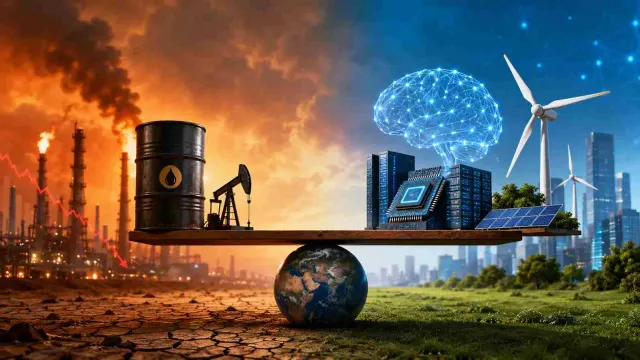
The global economy is being pulled in two opposite directions. On one side, geopolitical conflicts, particularly in the Middle East, are threatening energy supplies and fuelling inflationary pressures. On the other, the rapid expansion of artificial intelligence (AI) investment is emerging as a powerful engine of productivity and economic growth.
International Monetary Fund (IMF) Managing Director Kristalina Georgieva has described this emerging tension as a major challenge for the global economy. While energy disruptions pose a downside risk, the accelerating AI investment cycle is providing an important counterweight.
Energy shock remains a major threat
The conflict in the Middle East has raised concerns over disruptions to global oil and gas supplies. For economies heavily dependent on imported energy, a sustained increase in crude prices could quickly translate into higher inflation, increased import bills and weaker consumer purchasing power.
So far, the global economy has managed the energy shock better than initially feared. The use of oil and gas reserves, supplies from producers outside the Gulf region, growing renewable-energy capacity and lower energy consumption have helped contain the immediate impact.
However, the situation remains fragile. A sharp and prolonged rise in oil prices could intensify inflation while simultaneously slowing economic activity — a combination that would pose a difficult policy dilemma for central banks.
AI emerges as a counterweight
At the other end of the spectrum, AI is generating a wave of investment that is reshaping the global economy.
What began largely as a US-led investment cycle is now spreading across countries and industries. Governments and companies are investing heavily in data centres, semiconductors, advanced computing infrastructure and AI-enabled services.
The resulting expansion is supporting corporate earnings, capital expenditure and productivity, while also creating new markets and employment opportunities.
The AI boom, however, is not equally accessible to all economies. Countries with advanced digital infrastructure, capital and skilled workers are better positioned to capture its benefits. Those lacking these capabilities risk falling behind, potentially widening the global technology and productivity divide.
Developing economies face a double challenge
The two forces are affecting countries differently.
Oil-importing economies face rising energy costs and inflation, while countries integrated into the AI value chain can benefit from technology investment and productivity gains. Developing countries therefore face a particularly difficult situation: they must protect their economies from external energy shocks while simultaneously investing in the capabilities required to participate in the AI revolution.
The IMF has projected global growth at 3% in 2025 and 3.4% in 2026. Yet inflation remains a key risk. Another significant increase in oil prices could put additional pressure on central banks, forcing them to balance inflation control against the need to sustain economic growth.
What It Means for India
For India, this global tug-of-war presents both a vulnerability and an opportunity.
Oil dependence is the immediate risk
India imports more than 90% of its crude-oil requirements, making it particularly exposed to global energy-price fluctuations.
A sustained rise in crude prices could increase India's import bill, widen the trade and current-account deficits, put pressure on the rupee and raise transportation and production costs.
The impact would extend well beyond petrol and diesel. Higher energy costs can raise the price of fertilisers, irrigation, logistics and other agricultural inputs, eventually feeding into food inflation and reducing household purchasing power.
For India, therefore, energy security is not merely an external-sector concern. It is closely linked to inflation, food security, fiscal stability and economic growth.
AI offers a strategic opportunity
The global AI investment boom, meanwhile, could work in India's favour.
With a large technology workforce, a rapidly expanding digital economy and a huge domestic market, India is well placed to benefit from growing demand for AI and technology services.
Opportunities are emerging across AI-enabled services, cloud computing, data centres, semiconductor manufacturing, electronics and advanced digital infrastructure.
India's semiconductor push is particularly significant. Building domestic capabilities in chip manufacturing and electronics can help reduce strategic dependence on overseas supply chains while integrating India more deeply into global technology value chains.
Skills will determine the outcome
However, India's AI opportunity cannot be taken for granted.
AI and automation could disrupt traditional IT and business-process jobs, particularly those involving routine and repetitive tasks. The challenge, therefore, is to move from India's traditional strength in low-cost technology services towards higher-value capabilities in AI, advanced computing, semiconductors, robotics and deep technology.
This will require a major emphasis on reskilling, research and development, digital infrastructure and industry-academia collaboration.
Energy security needs renewed focus
The geopolitical uncertainty also strengthens the case for accelerating India's transition towards a more diversified energy system.
Expanding renewable energy, increasing nuclear capacity, strengthening strategic petroleum reserves, diversifying crude suppliers, improving energy efficiency and accelerating electric mobility can reduce India's exposure to external energy shocks.
The objective should not simply be to reduce oil imports, but to build an energy system capable of supporting India's long-term economic ambitions while remaining resilient to geopolitical disruptions.
A Test of India's Economic Resilience
The global economy is therefore entering a period in which energy insecurity and technological acceleration are developing simultaneously.
For India, the immediate challenge is to protect households and businesses from imported inflation and energy shocks. The longer-term opportunity lies in using the AI revolution to raise productivity, attract investment, create high-skilled employment and strengthen domestic manufacturing.
The countries that successfully navigate this transition will be those that can combine energy security with technological competitiveness.
For India, the strategic equation is increasingly clear:
Energy security + AI + Semiconductors + Skills + Manufacturing = Greater economic resilience.
The present global turbulence could therefore become more than a challenge for India. If managed effectively, it could provide an opportunity to accelerate the country's transition towards a more self-reliant, technology-driven and globally competitive economy.
Reader Feedback
Was this article useful?
Stay Connected
Get the next important story before you miss it.
Subscribe to the newsletter for trusted updates, or join our WhatsApp channel for quick top-story alerts from The Eastern Times.
WhatsApp Channel
Prefer instant alerts? Join our WhatsApp channel for top stories and breaking updates.
Join on WhatsApp