Advertisement

Beyond GDP: How Religion, Education and Marriage Shape India's Economy
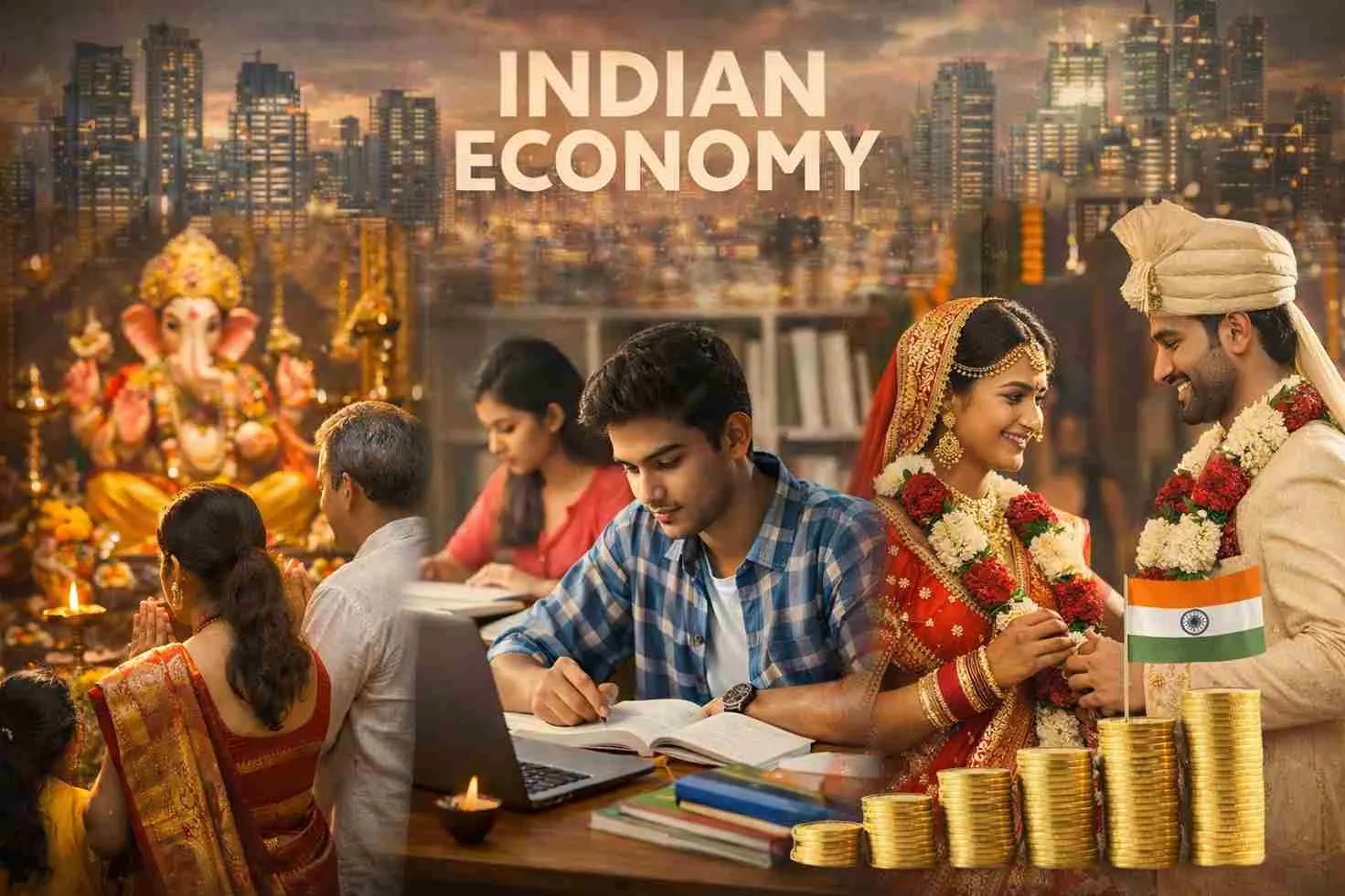
To understand the Indian economy properly, it is not enough to look only at GDP, inflation, or government policies. We must look inside Indian households. The everyday decisions families make—what to save for, when to borrow, and where to spend—tell a deeper story about how the economy actually functions.
If we closely observe household spending in India, three areas clearly stand out: religion, education, and marriage.
In India, religion is not merely a matter of personal faith. It is a regular component of family expenditure. The National Sample Survey (NSS) shows that Indian households spend a significant share of their non-food expenses on religious and ceremonial activities. This includes daily offerings, weekly temple visits, festivals, donations, pilgrimages, and rituals related to birth, marriage, and death.

Each expense may seem small individually, but together they add up—especially for lower- and middle-income families. In years with multiple ceremonies, families may exhaust their savings or even take informal loans. From a narrow economic perspective, such spending may appear unnecessary. However, in reality, religious expenditure often functions like social security. Temples and festivals bring people together, create informal support systems, and strengthen community bonds. Moreover, religious activities support local livelihoods—priests, flower sellers, transport workers, hotel owners, and small vendors all benefit. Thus, religious spending also contributes to economic activity.
Education is another major priority for Indian families. Most parents believe that education is the most reliable path to securing their children’s future. It is associated with better employment opportunities, higher income, and social mobility. As a result, families are willing to allocate a substantial portion of their income toward schooling.
Today, education expenses extend far beyond school fees. Families spend on coaching classes, digital devices, online learning platforms, transportation, hostel accommodation, and professional courses. Many parents even take loans to finance higher education, particularly in fields such as engineering, medicine, management, or overseas studies.
Families accept present financial pressure with the expectation of future returns. Education is viewed as an investment in human capital. However, when a significant number of educated youth migrate abroad for employment, the country does not fully reap the benefits of this investment. The financial burden is initially borne by families, but its long-term effects are felt at the macroeconomic level.
Marriage is perhaps the most visible and expensive component of India’s socio-economic structure. India’s wedding industry is worth billions of dollars annually. Millions of marriages take place each year, and the average wedding cost often exceeds a family’s annual income.
Families save for years, purchase gold, or take loans to organize weddings. From a purely economic standpoint, such expenses may seem excessive. Yet in India, marriage is not merely a personal milestone—it is a social institution that reflects family status and societal standing.
At the same time, weddings generate substantial economic activity. Jewelers, caterers, decorators, musicians, photographers, transport providers, and numerous small businesses rely heavily on wedding seasons for their income. In this way, wedding expenditure sustains a wide range of livelihoods.
When religion, education, and marriage are examined together, a clear pattern emerges. These expenditures are not arbitrary. They reflect India’s cultural values, social structures, and long-term aspirations. This also helps explain why household consumption forms the backbone of India’s GDP—accounting for around 60 percent of total economic output.
Cultural spending in India is not merely tradition; it is embedded in economic life. Religion provides social cohesion, education builds future security, and marriage reinforces social networks.
To truly understand the Indian economy, we must understand Indian families. Behind every economic statistic lies a story of belief, aspiration, responsibility, and social connection.
Original Author: Dr. Antarjeeta Nayak
Original Language: Odia
Translated and Edited by: The Eastern Times Editorial Team
About the Author

Dr. Antarjeeta Nayak is a researcher and columnist with a Ph.D. in Economics from NIT Rourkela and a recipient of ICSSR Doctoral and Post-Doctoral Fellowships. Her research focuses on poverty and tribal development.
She is the author of TribaNomics and Poverty: By Chance or By Choice, as well as Odia books including Mana Katha, Parikhyar Parikhya, Mun Bada Hele Adivasi Hebi, and the novel Kusum: Byabasthar Abyabastha re Adibasi. She received the ISSBD Grant (2022) and the Laadli Media Award (2025), and is the Founder Director of Abhibyakti Research and Development Foundation (ARDF).
