
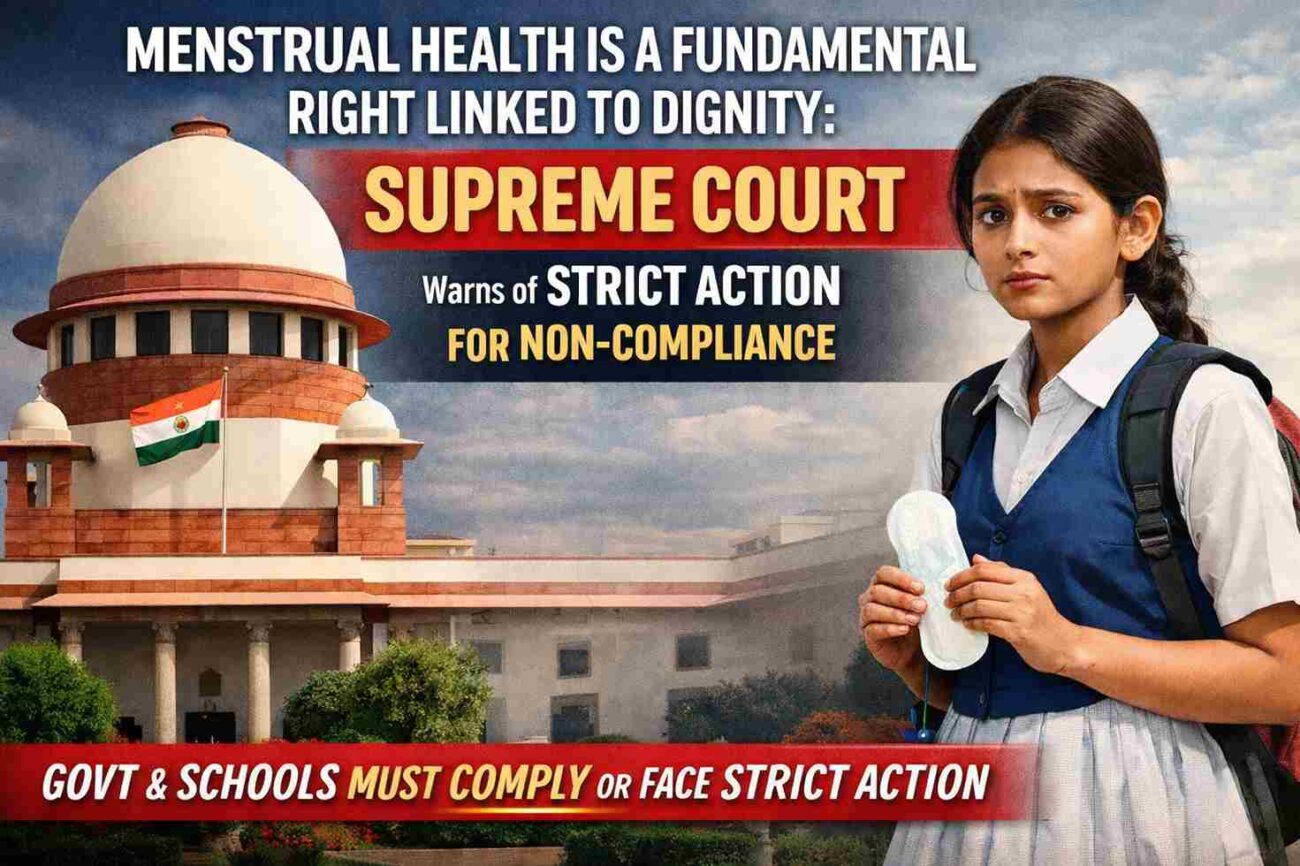
NEW DELHI – The Supreme Court of India has held that menstrual health is an integral part of the fundamental right to life and human dignity under Article 21 of the Constitution, observing that lack of menstrual hygiene facilities directly impacts girls’ education, equality, and dignity.
The Court ruled that school facilities like free pads and private toilets are no longer “extras”—they are a mandatory part of the Right to Education.

The bench, led by Justices J.B. Pardiwala and R. Mahadevan, slammed the lack of basic hygiene as a “constitutional failure”.
They noted that millions of girls are forced to skip school or drop out because they can’t afford pads or don’t have a private toilet—a problem they called “period poverty”.
The 5 Big Orders for Every School
To fix this, the Court issued a strict “to-do list” for all States and schools:
Free Sanitary Pads: Schools must provide free, biodegradable pads for girls in Classes 6 to 12.
Private Toilets: Every school must have separate, clean toilets for girls with 24/7 water and soap.
Vending Machines: Pads must be available via vending machines inside school toilets.
Safe Disposal: Schools must install incinerators or safe bins to dispose of used pads hygienically.
Emergency Kits: “MHM Corners” must be set up with spare uniforms and innerwear for emergencies.
Breaking the Silence
The judges emphasized that periods shouldn’t be a “hushed whisper” topic. They ordered that:
* Boys & Teachers must be sensitized: Male students and teachers must be educated to stop the teasing and stigma that often makes girls feel ashamed.
* National Policy: The Central Government must finalize a uniform plan to make sure these rules work in every village and city.
Also read: Odisha High Court Cancels SC/ST Promotion Notification on Procedural Grounds
What Happens if Schools Ignore the Law?
The Court is playing hardball to ensure this isn’t just a “paper promise”:
Private schools that fail to comply could be permanently shut down.
Govt officials will face legal action if they don’t provide the funds and facilities.
Surprise Checks: Education officers will conduct yearly inspections and even take anonymous feedback from the girls themselves to see if the pads and toilets are actually being provided.
Case Background:
click on icons to connect with us through official social media channels






Also Read:
