
News in Short
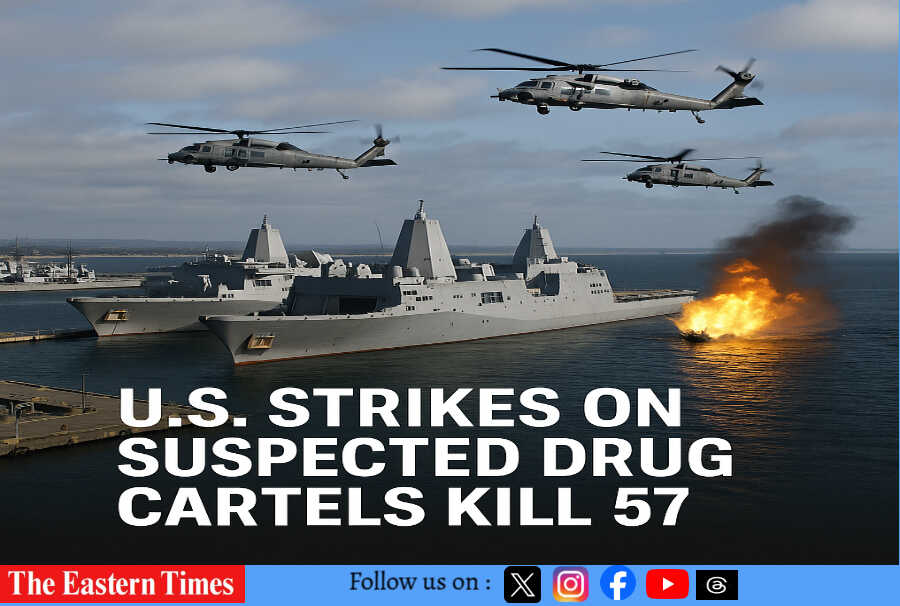
The U.S. military has carried out at least 13 strikes on suspected drug vessels in the eastern Pacific and Caribbean, killing about 57 people from Venezuela, Colombia, and Ecuador. The Trump administration said the targets were “drug trafficking terrorists” responsible for thousands of American deaths, but human rights groups condemned the attacks as unlawful killings of civilians. Legal experts have questioned the strikes’ legality under both U.S. and international law.
📰 News in Detail
Washington D.C., Oct 31: The Trump administration’s recent authorization of military strikes on suspected drug-trafficking vessels in the eastern Pacific and Caribbean has sparked global controversy, with human rights groups calling the killings illegal and experts questioning their legal basis under international law.
According to U.S. officials, the military conducted at least 13 deadly strikes, killing about 57 people — most of them from Venezuela, Colombia, and Ecuador. The administration labeled the victims as “drug trafficking terrorists,” claiming they were linked to cartels responsible for thousands of overdose deaths in the United States.

This marks a dramatic departure from the traditional U.S. approach of intercepting maritime drug shipments through the Coast Guard and prosecuting traffickers in courts. Instead, the administration designated several cartels as terrorist organizations and authorized the use of lethal military force, arguing that conventional law enforcement “failed to protect American lives.”
Human rights organizations, including Amnesty International, strongly condemned the strikes as extrajudicial killings, saying the U.S. was violating both domestic and international laws by using lethal force against civilians. Families of several presumed victims have also denied any connection of their relatives to drug trafficking or organized crime.
White House Legal Justification
The administration cited the President’s constitutional authority as commander-in-chief and his powers to conduct foreign relations as the legal basis for the strikes. Under the War Powers Act, Trump notified Congress that the U.S. was engaged in a “non-international armed conflict” against transnational criminal organizations.
In the notification, the White House argued that the cartels had become “unlawful combatants” and “non-state armed groups” whose activities — including drug trafficking, arms smuggling, and violence — amounted to an armed attack on the United States.
According to officials, this justification gives the U.S. military the right to act in self-defense, mirroring previous limited military actions carried out under presidents from both parties.
Legal and Ethical Concerns
However, legal experts are deeply divided. Critics say the administration’s rationale stretches the definition of self-defense far beyond what international law permits. Under established norms, nations may use force only in response to an imminent armed attack — a threshold the flow of illegal drugs does not meet.
“Declaring cartels as terrorists doesn’t automatically make them lawful military targets,” said one international law scholar. “Drug cartels are criminal enterprises, not insurgent movements or political groups like al-Qaeda.”
Moreover, the law of armed conflict requires nations to distinguish between combatants and civilians, something human rights advocates say the U.S. has failed to do. The administration has not released evidence identifying the individuals killed as legitimate military targets.
Political and Legal Fallout
Members of Congress from both parties have expressed concern. Several Democratic senators have demanded that the Department of Justice release the legal memos justifying the strikes. However, with Republicans controlling Congress and the president maintaining strong support among party voters, significant legislative pushback appears unlikely.
Legal challenges are also expected to face steep hurdles. U.S. courts traditionally defer to the president on matters of foreign policy and national security, and potential plaintiffs — including victims’ families — would face years of litigation with uncertain outcomes.
Two survivors of the strikes, repatriated to Colombia and Ecuador, were released by U.S. authorities, a move experts believe was intended to avoid judicial scrutiny.
While international tribunals could, in theory, take up the matter, such courts lack enforcement power. Analysts say this leaves the Trump administration largely free to continue the operations without immediate consequence.
A Dangerous Precedent
Observers warn that the strikes set a dangerous precedent by blurring the line between law enforcement and military warfare, potentially opening the door for similar actions by other nations.
“This move shifts the U.S. from targeting terrorists to targeting criminals with the same military tools,” said one former Pentagon official. “It erodes the distinction that has long protected civilians under international law.”
As the world debates the legality and morality of the policy, the Trump administration remains firm, arguing that the new approach will finally dismantle the cartels that have plagued the U.S. for decades — even as questions of legitimacy, accountability, and human rights grow louder.
Connect with us through social media
Facebook:
 https://www.facebook.com/profile.php?id=61577015427068
X (Twitter):
 https://x.com/tet_editor
Instagram:
 https://www.instagram.com/the_eastern_times_/?next=%2F&hl=en
Mail (Email):
 contact.theeasterntimes@gmail.com